The task can be modified depending on the individual experience and goals!
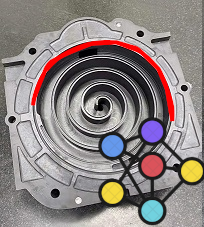
In modern electric automobiles electric refrigerant compressors are used both for cooling the traction battery and for interior climate control. Scroll compressors are frequently used for this purpose.
As part of a benchmarking project of the professorship, 3D scan data of scroll profiles are being collected to draw conclusions about stroke and dead volume. For precise volume measurement, it is necessary to convert the acquired scan data into CAD-capable surface models. However, the reconstruction of such models from point clouds or meshes presents a significant technical challenge: the complex geometries of the scroll profiles substantially complicate the surface reconstruction, meaning that classic reverse engineering approaches are often time-consuming and lead to inaccurate results.
Current reverse engineering advances utilize deep learning models to allow the deduction of CAD commands from point clouds. One of these is open-source, the installation and implementation of this model is essential. This approach however, is limited to simple line, arc and circle sketch commands and extrude operations. The core of the scroll compressor is a pair of interlocking spirals, which cannot be constructed by these simple commands. They can however be easily constructed with so called „splines“. Current datasets, on which the models are trained, do not contain these splines, thus no model can construct splines. The usage of splines in public CAD repositories is minimal. Therefore a synthetic dataset has to be created, filled with automatically generated examples of spline geometries. The dataset should contain geometries of varying complexity as well as simple commands like line, arc and circle to represent real-life complexity. Using this synthetic dataset, the already existing capabilities of the employed model can be further extended to include spline geometries within sketches.
To summarize: For the accurate reconstruction of scroll compressors, we want to establish and fine-tune a deep learning model capable of reverse engineering with a synthetic dataset filled with splines.
Requirements:
Basic Python experience
Basic CAD experience
Literature:
GenCAD3D: https://arxiv.org/abs/2509.15246